So I was going to wait till I was done with Peter Pan Predicaments to review current films again, but then I saw Lucy...Although I don't think I can even begin to properly criticize this film, it is a special kind of bad. A bad of unfathomably stupid writing, an artistic style that consists of boring imagery and way too obvious symbolism, and beyond uninteresting "I'm just doing this for the paycheck" acting. I don't know where to start with this, seriously everything is wrong.
Well let's start with the beginning. Right off the bat, it's a weird movie. The movie goes through human evolution in broad strokes, then proceeds to basically rip off Koyaanisqatsi by showing sped up images of people walking around and doing their jobs to imply how we've ruined society, except then the moral gets narrated over the montage by Scarlett Johansson (main character Lucy) because the audience is stupid and doesn't know how to think and analyze for themselves, I guess. This gets paid off, well I think it's the pay off at least, in a pretty stupid way, and has almost nothing to do with the plot of the film, so don't worry if you still don't get it.
After that, the real film starts as we smash right into Lucy having a discussion with her new boyfriend Richard (Pilou Asbaek). Richard is fairly unintelligible, but the basic gist is that he forces her to trade off a suitcase to his boss because he's afraid of doing it himself, not telling her what's in it. She goes in and it seems Richard's boss is about to come down to get it, when suited henchman come in, kidnap her and the case and kill Richard. This is interspersed with occasional quick cuts to some of that way too obvious symbolism. Like when Richard is trying to convince Lucy to go in with the case, the movie cuts to a mouse about to go for the cheese in a mouse trap (get it?). Or when the henchman kidnap Lucy, it cuts to a gazelle being attacked by cheetahs (GET IT?). This touch disappears after this scene, which thank god, but proves pretty quickly that this movie's style only extends far enough to suck the audience in with how "edgy" and "intellectual" it is without actually following through. Although you'll be wishing for at least the originality of these moments later on. The potential of a creative visual style that would match the new and exciting perspective the character gains is squandered by becoming boring CGI with the most average sci-fi look.
Continuing with the plot, Lucy is forced to open the briefcase by the drug lord, which we discover contains sacs of a synthetic drug. She then gets the sac put inside her body and is told she will become a drug mule. It's the only scene that's tense and also a bit darkly comedic and also the last we'll see of Scarlett Johansson caring about her performance, so I'm glad I savored this scene.
Lucy gets put in captivity and at one point where she gets kicked by one of her captors, the bag tears and the drug enters her system...and this is where the film goes from flawed to... I just sat for here 10 minutes seriously thinking of a word to describe it and couldn't think of anything that works for this film. Indescribable doesn't even work when it comes to this caliber of ineptitude. The drug causes her to slowly gain control of her brain, since humans only have control of 10% of their brains. This fact is given to us by Morgan Freeman, who plays a scientist who's only job is to expose information about brain capacity, foreshadow Lucy's case in the beginning, and be yet another person for Lucy to monologue to about the movie's philosophical ideas. You can probably figure out why I won't talk about him much.
Lucy getting more control of her brain "slowly" gives her god like powers and knowledge and "slowly" takes away her human emotions. The "slowly's" are in quotes for a reason. Because it doesn't happen slowly, really. Maybe there's a 10 minute process where she gains her powers, but really she gets that unlimited power over herself and others, as well as limitless knowledge, pretty quickly and there's not much transformation. As for emotional transformation...what emotions? Lucy says at one point that she's gradually losing her humanity, but I guess she's a complete liar because literally the first scene where the drug has entered her system she's killing the drug lord's henchman, taxi drivers, and completely innocent patients while their in surgery without any hesitation or remorse. Not to mention her voice and mannerisms instantly turn to a robotic monotone. Neither the script nor Johansson present any kind of emotional journey or inner struggle with what's happening.
That leads me to my next point, actually: There is zero conflict. She doesn't struggle with these newfound powers and the negative side to it all, or show any fight against what's happening to her, or show a want to stay human. There's this one scene where difficulties begin to arise, where she begins to disintegrate, but instantly solves that and it's never brought up again. Then there's the whole 10 seconds that the movie spends showing Lucy's struggle with trying to stay human. There's this cop guy with the personality of styrofoam that starts going around with Lucy, "helping" her when she clearly doesn't need the help. When he finally asks her why she's been carting him around, she responds by saying that she needs him there to remember human feelings again. And that's literally all we get about any sign of humanity or dimensionality, those two little moments.
The lack of internal conflict wouldn't be so bad, it is after all only an 89 minute movie, so there might not have been the time, except there's no real external conflict either. The only antagonists in the movie are a bunch of gun wielding drug lords, and since it's established pretty early on that Lucy has unlimited control over others, there's no tension. The whole movie is her, along with pointless one dimensional cop guy, going around killing the bad guys without any struggle and displaying ways her powers are awesome for the audience. It's really just running out the clock till the end. Lucy can do anything to anybody at anytime and figure out any problem she needs to without putting in any actual effort. No internal conflict, no external conflict, there's nothing interesting driving this movie forward.
So then, after the movie drags into it's 100th hour of Lucy being a "badass", the movie gets to it's climax. Her objective throughout most of the film is to get to this university where Morgan Freeman and some other guys in lab coats are; so she can share her newfound knowledge with them. I guess she can't just do that over the phone or facetime, and I also guess teleportation just isn't included in those unlimited powers. So she gets there and while the villains and some cops are outside shooting at each other, she time travels and sees Times Square throughout the centuries in a kinda visually interesting scene, but it's too late to get me to care. Then she ends up in front of Lucy, you know, the creature from millions of years ago that was discovered with a much fuller skeleton than ever found before? Then Lucy, sitting in her chair above apeman Lucy, sticks a hand down and points out a finger, and apeman Lucy sticks a hand up and points out a finger, their fingertips about to touch (GEEEEEEEETTTTT IIIIIITTTTT!?!?!?!?!?) when Lucy disappears.
She gets back to the lab and explains the piece of information to the lab coat guys that will relieve mankind and answer all of our questions: that mathematical and scientific measurements society has created are false (one plus one doesn't equal two) and time is the only true measurement. There's your payoff for the beginning. Time has had nothing to do with the rest of the movie, and anyways people do focus on time as a pretty big measurement anyway, so really this whole deep monologue is pretty pretentious. I can't imagine anyone actually feeling enlightened by this.
And if you still honestly care by this point and aren't just waiting for the credits to start rolling, her brain reaches 100% and she basically turns into god, then the movie ends with one final ego-stroke. Johansson states that "life was given to us a billion years ago. Now you know what to do with it", which I guess means this movie thinks we need to focus on time more? Yeah, the pretense is really frustrating, but that only scratches the surface of the wrong in this movie.
The writing is terrible. The conflict isn't a real conflict, the inner battle and any sign of humanity gets slightly hinted at then completely dropped, the characters that aren't Lucy or the drug dealers just stay in the movie long after they're needed and contribute nothing, there's no transformation as Lucy gains powers and loses emotions, the list of wrongness in the script goes on for miles.
The acting is terrible. Johansson starts off being engaging, but once the drug sets in, she instantly becomes this robot with no emotion instead of transforming into that, and becomes completely uninteresting. On top of that, most of the other actors clearly don't care because their characters are mostly pointless and one-dimensional, and they know it.
The visual style is terrible. The effects are uncreative and the symbolism is incredibly less smart than the movie thinks it is.
And it never becomes so bad it's good. Lucy isn't inept enough, so it can convince you it's a real film, but it's too inept to actually be an enjoyable film. It ends up being really boring, and that is the worst crime a film can commit.
Wednesday, July 30, 2014
Friday, July 25, 2014
Peter Pan Predicaments: Hook
Strap in kids, this is gonna be a long one.
As someone who is a gigantic Spielberg fanboy, with his classics being some of the first films I watched when I became obsessed with film years ago, and also as someone who is very interested in the morality of Peter Pan, Hook hurts...a lot.
For those who are unaware or just don't remember this film, which is very likely, Hook is centered around the idea, stated in the tagline, of "What if Peter Pan Grew Up?"
Keep this concept in mind as I dive into the characters and story that Hook sets up in the first act. So Peter Pan is a money hungry, business-obsessed banker that completely ignores and never cares about his kids and spending time with his family. Peter Pan. And how does the movie explain this complete 180 of Peter, a character that has become known to society as the boy who would never grow up and stay young and adventurous forever, into the worst grown up parent ever? By not doing it at all. The movie shows us this one-dimensionally horrible adult figure and expects us to not only accept that it's a realistic character, but also that it's Peter Pan. The problem is that a movie can say whatever it wants, but we can't believe that it's true unless it gets developed. Especially if it's an idea as hard to believe as this. It could've been an interesting set up for a character if we got the backstory, the transformation from the youthful high spirited hero that we all know him as to a terrible adult and father. It seems like with "What if Peter Pan Grew Up?" being the tagline that this movie was heavily advertised with and supposedly centered around, there would be at least a little focus on Peter actually growing up. It's a whole two and a half hours long yet with that extensive amount of time the question never gets delved into. Really, it doesn't even get answered. The closest we get is a flashback scene at around the end of act II where Peter finally remembers being Peter Pan in Neverland, but even then it feels like a missed opportunity. It completely avoids any possible character depths and just shows a totally nice Peter even as a grown up, so now it makes even less sense why we only saw him be a terrible person in the beginning. The scene also comes too late, as by the time we see Peter acting as a genuinely good person, we're way too far into the movie to care about this sudden development. Where were any of these redeemable moments at the beginning of the movie, to make a more dimensional character that the audience is more interested in following?
And to add on to how much the backstory for grown up Peter is basically non-existent, remember how I've said that Peter Pan is a character who is established in culture as "the boy who would never grow up"? Well the movie needs a better reason for Peter to leave Neverland, move to London and grow up than the one given in the movie. What the movie provides is that Peter watched Wendy's granddaughter, Moira, sleeping and "something changed in him forever". In that moment he officially decides to leave his only home he's always been scared of leaving, with the only incentive being, to remind you, watching a girl sleep for a few seconds. I really don't believe Peter would make such a life changing decision that he's doggedly refused to make before based on something as flimsy as that. And there are better ways to go about it, too, like if Peter took Moira to Neverland and decided he didn't want to lose her like he lost Wendy, so he stays with her. That makes a lot more sense with the character. And this movie is already two and a half hours, would adding in another few minutes for that really be too much?
But really, everything about the completely unbelievable reverse in Peter's character was done just for the shock effect of Peter Pan being the opposite of what we all know him as. And it being done without any effort in creating a believable backstory or any dimensionality, making the whole concept impossible to swallow, well it's all only the tip of the iceberg of what's wrong with this movie. Really. Because that is all just the set up of the character, but the character arc is a whole other mess.
So Peter's basic character arc is that he has to relearn how to be the child hero Peter Pan and find his happy thought so he can fly and fight Captain Hook, therefore getting his children back. Ok, fine, that is an acceptable plot that can work. Reading through a synopsis, it really isn't that bad. The biggest problem with the arc is that the movie exists too heavily in extremes, and it switches between the extremes way too quickly. How the movie makes Peter to be this one dimensionally terrible person that isn't believable at all, well that same rule about a feeling of falseness applies to when Peter goes through the character arc. Where Peter turns from stick in the mud to acting like an over active child, it happens in one scene, not even a montage, just a scene. I can't believe that the original Peter Pan turned into a cold workaholic, and I can't believe that the cold workaholic turned into the actual Peter Pan within the course of minutes, effected by essentially nothing.
After that, looking as far as Peter's character arc, it gets a bit better. The rest of the arc is Peter realizing that his happy thought that will allow him to fly is being a father. A good idea, and the scene of realization shows true understanding of Peter Pan. In an otherwise shallow movie that sloppily handles it's ideas and characters, this one scene knows that the original character of Peter Pan is incomplete. He lives a non-life where none of his experiences truly matter and he doesn't get exposure to the joys of growing up and caring for others, actually living. So this movie shows a Peter who actually grew up and has their happiest thought be something that displays a joy and wonder of maturing and growing up. It's a deep little moment that I actually really like.
But then the character goes right back to being this one dimensional child throughout the rest of the movie. It feels way too forced and lazy that he would become as childlike as to climb up poles to the window and quit his job with no hesitation and then throw the phone out the window. There's a difference between being a good father and becoming a child again, and after what was established with Peter's happiest memory, it feels like this movie doesn't even understand the psychological complexities it tried to add in. Even ignoring that, after spending such a long run time with such an over the top, fake seeming lead character that I didn't connect to, I never to really care in seeing him be suddenly so joyous and fun loving.
"But it's a family film" might be the first argument I hear in defense of this film, "it has to be extreme to get kids to understand". Well, what about Mary Poppins? A movie with a very similar character with a similar arc and similar ending in the form of Mr. Banks. However, where Peter is just a terrible father because the script says so, Banks is stern because he knows his children are fairly wild in causing so many nannies to quit and believes they need discipline, and his subtler dialogue and actions perceive that he has a believably strict personality, while still seeming human. And while the arc probably benefits from not taking up the entire movie, it works also for showing Banks slowly realize the wrong in ignoring his children for work, gradually go through the arc instead of all at once. Then it culminates in one moment of childishness in his realization of how he can become a better father, before it subdues back and he becomes a sensibly loving father by simply going out and flying a kite, not screaming at the top of his lungs and climbing up poles. Mary Poppins, an absolute classic film in american cinema, works in large part because of the realism of this character and how he learns.
So the main character, character arc and morality of "good parent = manchild" is pretty terrible. But even though that's the main focus of the movie, there's still a movie outside of that. A movie that tries to establish a fantasy world and entertaining side characters, and one that already has the basics of that world established from it's source material. And how is that side of the movie? It sucks too. A lot.
First of all, Hook clearly does not care about J.M. Barrie's Peter Pan despite the fact it keeps trying to fool you into thinking it does. And that's beside what I've stated of the morality being "good parent = manchild", which is fairly the opposite of Barrie's original message that we all have to grow up eventually. The movie also cuts out famous lines from Barrie's story and haphazardly glues them in the script, without any care for the actual meaning. The most egregious example is in the climax, when Peter is fighting Capt. Hook and says "to die will be a great adventure". In Barrie's Peter Pan, this famous line shows Peter as brave, but also furthers the idea that he really has no respect for life, even his own, a character flaw present throughout the book. It's a bittersweet little delve into the psyche of Peter, but in the movie, when Peter says this it's supposed to portray Peter as incredibly brave. We are supposed to cheer Peter on with this oh so courageous line.
This movie came out in the 90s, at the time when a lot of family films and t.v. shows had a focus on not being timeless but desperately appealing to the rebellious generation, as Hollywood family producers probably put it: "hip with the cool cats". This was present in the live action family sports films that were present in abundance and the Disney Afternoon shows that came later in the 90s. And the lost boys are really badly 90s-ified in this film. They ride skateboards and play basketball and say totally hip catchphrases like "Bangarang". And then the movie goes and makes a lost boy that's a fashion obsessed guido and one that's fat and his entire character is just being fat and dumb. Sure, there was a "fat one" in the original set of lost boys, but they didn't make as big of a deal out of it as this. The look of this Neverland and the way the kids act doesn't resemble Neverland; a jungle paradise completely disconnected from society, it just resembles a dated 90s kids hideout. And the movie never tries to explain why it would be 90s-ified with any in world reason either. And then there's Julia Roberts playing Tinkerbell but clearly not knowing what the character of Tinkerbell is supposed to be, the Captain Hook hookers and the climax keeps going and going till it ends with the laziest "death" of Hook where he just disappears, etc, etc. There are a lot of weird screw ups and lazy dated revisions, but at least Dustin Hoffman as Captain Hook is great. He's always extremely in character and delivers every line and action with a real sense of joyfulness. Even the scenes leading up to his reveal are really interesting, where he kidnaps Peter's kids and there's a great scene where a hook is carried to him throughout the pirate village with people starting to follow behind. There's a lot of interesting build up behind the character, and Hoffman doesn't disappoint and keeps you, well, hooked. (Yes I just used a pun related to the movie, sue me)
Unfortunately, even though the movie is named after the inimitable character of Hook, it's about Peter Pan and his character arc. A character arc with terribly uninteresting emotions centered around an unexplored concept with an ending that seems to further push the "never grow up" idea, in a movie world with awkward screw ups and dated, pandering revisions.
As someone who is a gigantic Spielberg fanboy, with his classics being some of the first films I watched when I became obsessed with film years ago, and also as someone who is very interested in the morality of Peter Pan, Hook hurts...a lot.
For those who are unaware or just don't remember this film, which is very likely, Hook is centered around the idea, stated in the tagline, of "What if Peter Pan Grew Up?"
Keep this concept in mind as I dive into the characters and story that Hook sets up in the first act. So Peter Pan is a money hungry, business-obsessed banker that completely ignores and never cares about his kids and spending time with his family. Peter Pan. And how does the movie explain this complete 180 of Peter, a character that has become known to society as the boy who would never grow up and stay young and adventurous forever, into the worst grown up parent ever? By not doing it at all. The movie shows us this one-dimensionally horrible adult figure and expects us to not only accept that it's a realistic character, but also that it's Peter Pan. The problem is that a movie can say whatever it wants, but we can't believe that it's true unless it gets developed. Especially if it's an idea as hard to believe as this. It could've been an interesting set up for a character if we got the backstory, the transformation from the youthful high spirited hero that we all know him as to a terrible adult and father. It seems like with "What if Peter Pan Grew Up?" being the tagline that this movie was heavily advertised with and supposedly centered around, there would be at least a little focus on Peter actually growing up. It's a whole two and a half hours long yet with that extensive amount of time the question never gets delved into. Really, it doesn't even get answered. The closest we get is a flashback scene at around the end of act II where Peter finally remembers being Peter Pan in Neverland, but even then it feels like a missed opportunity. It completely avoids any possible character depths and just shows a totally nice Peter even as a grown up, so now it makes even less sense why we only saw him be a terrible person in the beginning. The scene also comes too late, as by the time we see Peter acting as a genuinely good person, we're way too far into the movie to care about this sudden development. Where were any of these redeemable moments at the beginning of the movie, to make a more dimensional character that the audience is more interested in following?And to add on to how much the backstory for grown up Peter is basically non-existent, remember how I've said that Peter Pan is a character who is established in culture as "the boy who would never grow up"? Well the movie needs a better reason for Peter to leave Neverland, move to London and grow up than the one given in the movie. What the movie provides is that Peter watched Wendy's granddaughter, Moira, sleeping and "something changed in him forever". In that moment he officially decides to leave his only home he's always been scared of leaving, with the only incentive being, to remind you, watching a girl sleep for a few seconds. I really don't believe Peter would make such a life changing decision that he's doggedly refused to make before based on something as flimsy as that. And there are better ways to go about it, too, like if Peter took Moira to Neverland and decided he didn't want to lose her like he lost Wendy, so he stays with her. That makes a lot more sense with the character. And this movie is already two and a half hours, would adding in another few minutes for that really be too much?
But really, everything about the completely unbelievable reverse in Peter's character was done just for the shock effect of Peter Pan being the opposite of what we all know him as. And it being done without any effort in creating a believable backstory or any dimensionality, making the whole concept impossible to swallow, well it's all only the tip of the iceberg of what's wrong with this movie. Really. Because that is all just the set up of the character, but the character arc is a whole other mess.
So Peter's basic character arc is that he has to relearn how to be the child hero Peter Pan and find his happy thought so he can fly and fight Captain Hook, therefore getting his children back. Ok, fine, that is an acceptable plot that can work. Reading through a synopsis, it really isn't that bad. The biggest problem with the arc is that the movie exists too heavily in extremes, and it switches between the extremes way too quickly. How the movie makes Peter to be this one dimensionally terrible person that isn't believable at all, well that same rule about a feeling of falseness applies to when Peter goes through the character arc. Where Peter turns from stick in the mud to acting like an over active child, it happens in one scene, not even a montage, just a scene. I can't believe that the original Peter Pan turned into a cold workaholic, and I can't believe that the cold workaholic turned into the actual Peter Pan within the course of minutes, effected by essentially nothing.
After that, looking as far as Peter's character arc, it gets a bit better. The rest of the arc is Peter realizing that his happy thought that will allow him to fly is being a father. A good idea, and the scene of realization shows true understanding of Peter Pan. In an otherwise shallow movie that sloppily handles it's ideas and characters, this one scene knows that the original character of Peter Pan is incomplete. He lives a non-life where none of his experiences truly matter and he doesn't get exposure to the joys of growing up and caring for others, actually living. So this movie shows a Peter who actually grew up and has their happiest thought be something that displays a joy and wonder of maturing and growing up. It's a deep little moment that I actually really like.
But then the character goes right back to being this one dimensional child throughout the rest of the movie. It feels way too forced and lazy that he would become as childlike as to climb up poles to the window and quit his job with no hesitation and then throw the phone out the window. There's a difference between being a good father and becoming a child again, and after what was established with Peter's happiest memory, it feels like this movie doesn't even understand the psychological complexities it tried to add in. Even ignoring that, after spending such a long run time with such an over the top, fake seeming lead character that I didn't connect to, I never to really care in seeing him be suddenly so joyous and fun loving.
"But it's a family film" might be the first argument I hear in defense of this film, "it has to be extreme to get kids to understand". Well, what about Mary Poppins? A movie with a very similar character with a similar arc and similar ending in the form of Mr. Banks. However, where Peter is just a terrible father because the script says so, Banks is stern because he knows his children are fairly wild in causing so many nannies to quit and believes they need discipline, and his subtler dialogue and actions perceive that he has a believably strict personality, while still seeming human. And while the arc probably benefits from not taking up the entire movie, it works also for showing Banks slowly realize the wrong in ignoring his children for work, gradually go through the arc instead of all at once. Then it culminates in one moment of childishness in his realization of how he can become a better father, before it subdues back and he becomes a sensibly loving father by simply going out and flying a kite, not screaming at the top of his lungs and climbing up poles. Mary Poppins, an absolute classic film in american cinema, works in large part because of the realism of this character and how he learns.
![]() |
| The Lost Boys' hideout in Hook |
First of all, Hook clearly does not care about J.M. Barrie's Peter Pan despite the fact it keeps trying to fool you into thinking it does. And that's beside what I've stated of the morality being "good parent = manchild", which is fairly the opposite of Barrie's original message that we all have to grow up eventually. The movie also cuts out famous lines from Barrie's story and haphazardly glues them in the script, without any care for the actual meaning. The most egregious example is in the climax, when Peter is fighting Capt. Hook and says "to die will be a great adventure". In Barrie's Peter Pan, this famous line shows Peter as brave, but also furthers the idea that he really has no respect for life, even his own, a character flaw present throughout the book. It's a bittersweet little delve into the psyche of Peter, but in the movie, when Peter says this it's supposed to portray Peter as incredibly brave. We are supposed to cheer Peter on with this oh so courageous line.
This movie came out in the 90s, at the time when a lot of family films and t.v. shows had a focus on not being timeless but desperately appealing to the rebellious generation, as Hollywood family producers probably put it: "hip with the cool cats". This was present in the live action family sports films that were present in abundance and the Disney Afternoon shows that came later in the 90s. And the lost boys are really badly 90s-ified in this film. They ride skateboards and play basketball and say totally hip catchphrases like "Bangarang". And then the movie goes and makes a lost boy that's a fashion obsessed guido and one that's fat and his entire character is just being fat and dumb. Sure, there was a "fat one" in the original set of lost boys, but they didn't make as big of a deal out of it as this. The look of this Neverland and the way the kids act doesn't resemble Neverland; a jungle paradise completely disconnected from society, it just resembles a dated 90s kids hideout. And the movie never tries to explain why it would be 90s-ified with any in world reason either. And then there's Julia Roberts playing Tinkerbell but clearly not knowing what the character of Tinkerbell is supposed to be, the Captain Hook hookers and the climax keeps going and going till it ends with the laziest "death" of Hook where he just disappears, etc, etc. There are a lot of weird screw ups and lazy dated revisions, but at least Dustin Hoffman as Captain Hook is great. He's always extremely in character and delivers every line and action with a real sense of joyfulness. Even the scenes leading up to his reveal are really interesting, where he kidnaps Peter's kids and there's a great scene where a hook is carried to him throughout the pirate village with people starting to follow behind. There's a lot of interesting build up behind the character, and Hoffman doesn't disappoint and keeps you, well, hooked. (Yes I just used a pun related to the movie, sue me)
Unfortunately, even though the movie is named after the inimitable character of Hook, it's about Peter Pan and his character arc. A character arc with terribly uninteresting emotions centered around an unexplored concept with an ending that seems to further push the "never grow up" idea, in a movie world with awkward screw ups and dated, pandering revisions.
Sunday, July 13, 2014
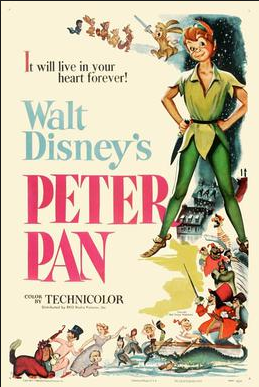
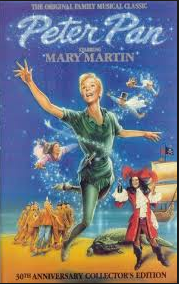
Peter Pan Predicaments: Disney's Peter Pan/1960 NBC TV movie
So Peter Pan. I am compelled by this character and the different ways he, as well as the other characters and the story, are interpreted and framed. And Peter Pan and the surrounding characters have been portrayed through many varying interpretations and spin-offs of the original, with different takes on the morality of the story. So in departure from reviewing current films, I will be analyzing the five most notable and well known Peter Pan movies that have something to do with the morality of the story and characters: Disney's Peter Pan, the NBC TV movie/original Broadway Musical, Hook, Return to Neverland, and the 2003 Peter Pan. No, this does not cover all bases:the 1920 Peter Pan, the Peter and the Starcatchers book series/play, Peter Pan and the Pirates, Peter Pan in Scarlet, Finding Neverland, as well as others, won't be covered, for different reasons.
But for now, these are the five I have decided upon, and where better to start than the most nostalgic two of the bunch? Sure, for most of what I will be analyzing this month, there will definitely be some people who have nostalgic ties, but the TV movie with Mary Martin seems to remain fairly nostalgic for the baby boomer generation, and Disney's film has become, to many, the definitive Peter Pan entity, because it's Disney, parental guardian via film of every generation since the 1930s, so their well liked films immortalize and are watched for decades to come. And as both these films come from the same era, an era before there became a demand for more emotionally substantive children's films, they both have the same fully clean, innocent way of telling the story and portraying Peter.
The clean storytelling shouldn't be a problem within itself, until you look at the original play/novel that J.M. Barrie wrote: Peter and Wendy (or some variation on that title). In it, Peter is a very dark protagonist. He isn't just "the boy who refused to grow up" because of the joys and innocence of childhood, it's moreover because he's afraid of the responsibilities that come with growing up. He kills his followers/"friends" the lost boys when they show signs of growing up, in fights against pirates, he only saves people from dying because of how great it will make him look and not for the sake of saving a life, and at the end, Peter tries to bar the window to Wendy and her brother's room, forcing them to not return home and stay with Peter. It all frames Peter as being not a hero, but an immature child with no empathy or respect for human life, and one genuinely scared of maturing.
Do we get any of this realistic representation of a kid who ran away to never grow up in either the Disney film or musical? Nope, instead we get Peter's that are perfect infallible heroes with all of the psychological complexity cut out. They're both, very simply, representations of solely the innocence of childhood. The two stories handle the character slightly different though.
The Disney film is a bit confused about it's portrayal of Peter, and the surrounding characters. Not enough to be jarring, but clearly Disney had a hard time taking the dark, emotionless anti-hero of Peter and turning it into the fun, lighthearted Peter that they wanted, while still keeping the same basic plot as Barrie's story intact. Sure, it's easy to cut out Peter killing lost boys and forgetting who people are, a lot of the dark side of the character, but there's this one weird scene that's based on a scene from the original Peter and Wendy that reveals some darkness of Peter. In the Disney movie, the scene that really starts off the 3rd act is where Wendy, as well as her brothers Michael and John, decide to return home and be with their family again. The lost boys, hearing the wonders of mothers from Wendy, decide they want to go to England and grow up with them. Peter becomes angry at this and says they can go but if they do grow up, they can never come back to Neverland. He storms off but cockily says that they'll be back as they leave, Wendy seeming sad for Peter...or at least I think she seems sad for Peter, it's pretty skimmed over. It's only one scene, but I bring it up because it's the only peek into the darker, imperfect side of Peter, the only scene where he's framed semi-negatively. This setup for a potential character arc, wether for Peter, Wendy, or both, is completely dropped after this. We go right back to Peter being the perfect hero and Wendy (pretty blindly) believing he's perfect, as in literally the next scene the Darlings and lost boys are captured by the pirates and Wendy insists that Peter will come to save them.
In the time following this scene we get nothing of Wendy realizing that Peter isn't the perfect hero and she needs to grow up, so when Wendy tells her parents that she's ready to grow up at the end of the film, the moment that's supposed to be the end of her character arc, it comes off as phoned in and random. That's why most fans of the movie, at least as it seems, take away the terrible moral of "never grow up" or some variation on that. Sure, Wendy decides to grow up at the end, but the character arc is disconnected, we barely see what should be the beginning of the arc, then we get the end of it, without seeing the arc actually occur. However Peter is the star of the show: he is the absolute hero that will always save the day and do nothing wrong, so naturally the audience remembers him more. The movie tries to bring in a solid moral, but sacrifices actual development of that so we can focus on the world and Peter's funny cocky self. So why would they even bother? Clearly the creators didn't really care about the moral, so they might as well skip any pretense they want to be like the original or include a moral at all, make it a full on childlike adventure escapism. Just take out the one bit of dimensionality of Peter you put in and Wendy's choppy character arc, if they're not willing to develop it. Then, when fans interpret the moral as being "never grow up", it's just a bad fan interpretation when there's no moral there, instead of the film just not knowing how to handle it's moral.
However the Broadway musical is definitely not confused about the moral it's presenting, and works it in well. Too bad it's kind of a terrible moral. That's not to say it's a terrible movie, it has it's charm, if it's a bit overlong and awkward due to having to transfer from Broadway to television. And props to the musical for keeping it entirely a light hearted adventure with Peter being the perfect hero. It may completely desecrate the original, but at least it's consistent, and more so than the Disney film. The only problem is the ending. Set years after the events of the story, Wendy is grown up with her own child, Jane. Peter Pan, having no concept of time, shows up to take Wendy back to Neverland, unaware she has grown up. It's not a bad scene, until we get to the moral that drops in like a nuke. Peter is about to take Jane to Neverland with him, when Wendy stops them to say if only she could go with them to protect her daughter. And Peter responds by saying "You can't, you see Wendy, you're too grown up." I take umbrage with this line. It is a line taken directly from Barrie's book, with the same amount of moralistic weight behind it, so it seems like it would work. But within the context of the musical, the moral turns from the really solid, unique one from the original story to awful, abjectly awful. Like I've said, in Barrie's original story, the darker side of the character is accented just as much as the light, fun side. So at the very end, when Wendy is told she's too grown up to go to Neverland, the major theme comes off as "childhood is a special time, but we all have to grow up and mature eventually" because the whole story building up to that moment has shown the negativity of a child who is scared of growing up. In the musical, the whole story building up to the moment shows Peter as a completely innocent, perfect hero who wants to simply live the wonders of childhood because it's fun. When the same line comes up at the end of the musical, it feels more like Peter is taunting Wendy, and the moral that comes across is more along the lines of "never grow up cause grown ups don't have fun". The musical wants to fool you into thinking there's something deep in it by using Barrie's words, but it comes in a completely different context, and if you give it an ounce of thought, you find the morality displayed is terrible.
So which is better, to be confused about the moral and display that throughout or to just present a terrible one and only have that at the end? Out of the 5 films I'm reviewing, these are the two where the morality tale is most detached from the actual story. And outside of moralistic issues, these two films are fine. The Disney film is a fun little adventure with memorable songs, interesting characters, a quiet and leisurely atmosphere, and Peter is really fun to follow when he is just being a one dimensional hero. And the TV special is a mixed bag. The actors clearly struggle in transitioning from large Broadway stage to close up filming, and the songs are less memorable than Disney's, however there's still some innocent charm. And maybe these are considered definitive classics because of that detachment. Disney's Peter Pan has definitely become ingrained in american culture, and the musical has been revived 3 times on broadway. With that, the "cute" idea of never growing up so we can all be like Peter Pan forever has also become ingrained in culture. It might seem harmless at first, after all, it's just a kid's film, right? But the negative effects definitely exist all because these stories don't know how to handle the morals they try and fail to bring up. It's there through Peter Pan syndrome existing, through just the public obsession with quotes that make it seem like it's ok to not grow up and mature spreading across the internet, and clearly some famous pop stars' life was destroyed mostly because of his want to stay childlike forever because he never got an actual childhood himself and became influenced by Disney's Peter Pan...but I'm sure none of that really matters.
The clean storytelling shouldn't be a problem within itself, until you look at the original play/novel that J.M. Barrie wrote: Peter and Wendy (or some variation on that title). In it, Peter is a very dark protagonist. He isn't just "the boy who refused to grow up" because of the joys and innocence of childhood, it's moreover because he's afraid of the responsibilities that come with growing up. He kills his followers/"friends" the lost boys when they show signs of growing up, in fights against pirates, he only saves people from dying because of how great it will make him look and not for the sake of saving a life, and at the end, Peter tries to bar the window to Wendy and her brother's room, forcing them to not return home and stay with Peter. It all frames Peter as being not a hero, but an immature child with no empathy or respect for human life, and one genuinely scared of maturing.Do we get any of this realistic representation of a kid who ran away to never grow up in either the Disney film or musical? Nope, instead we get Peter's that are perfect infallible heroes with all of the psychological complexity cut out. They're both, very simply, representations of solely the innocence of childhood. The two stories handle the character slightly different though.
The Disney film is a bit confused about it's portrayal of Peter, and the surrounding characters. Not enough to be jarring, but clearly Disney had a hard time taking the dark, emotionless anti-hero of Peter and turning it into the fun, lighthearted Peter that they wanted, while still keeping the same basic plot as Barrie's story intact. Sure, it's easy to cut out Peter killing lost boys and forgetting who people are, a lot of the dark side of the character, but there's this one weird scene that's based on a scene from the original Peter and Wendy that reveals some darkness of Peter. In the Disney movie, the scene that really starts off the 3rd act is where Wendy, as well as her brothers Michael and John, decide to return home and be with their family again. The lost boys, hearing the wonders of mothers from Wendy, decide they want to go to England and grow up with them. Peter becomes angry at this and says they can go but if they do grow up, they can never come back to Neverland. He storms off but cockily says that they'll be back as they leave, Wendy seeming sad for Peter...or at least I think she seems sad for Peter, it's pretty skimmed over. It's only one scene, but I bring it up because it's the only peek into the darker, imperfect side of Peter, the only scene where he's framed semi-negatively. This setup for a potential character arc, wether for Peter, Wendy, or both, is completely dropped after this. We go right back to Peter being the perfect hero and Wendy (pretty blindly) believing he's perfect, as in literally the next scene the Darlings and lost boys are captured by the pirates and Wendy insists that Peter will come to save them.
In the time following this scene we get nothing of Wendy realizing that Peter isn't the perfect hero and she needs to grow up, so when Wendy tells her parents that she's ready to grow up at the end of the film, the moment that's supposed to be the end of her character arc, it comes off as phoned in and random. That's why most fans of the movie, at least as it seems, take away the terrible moral of "never grow up" or some variation on that. Sure, Wendy decides to grow up at the end, but the character arc is disconnected, we barely see what should be the beginning of the arc, then we get the end of it, without seeing the arc actually occur. However Peter is the star of the show: he is the absolute hero that will always save the day and do nothing wrong, so naturally the audience remembers him more. The movie tries to bring in a solid moral, but sacrifices actual development of that so we can focus on the world and Peter's funny cocky self. So why would they even bother? Clearly the creators didn't really care about the moral, so they might as well skip any pretense they want to be like the original or include a moral at all, make it a full on childlike adventure escapism. Just take out the one bit of dimensionality of Peter you put in and Wendy's choppy character arc, if they're not willing to develop it. Then, when fans interpret the moral as being "never grow up", it's just a bad fan interpretation when there's no moral there, instead of the film just not knowing how to handle it's moral.
However the Broadway musical is definitely not confused about the moral it's presenting, and works it in well. Too bad it's kind of a terrible moral. That's not to say it's a terrible movie, it has it's charm, if it's a bit overlong and awkward due to having to transfer from Broadway to television. And props to the musical for keeping it entirely a light hearted adventure with Peter being the perfect hero. It may completely desecrate the original, but at least it's consistent, and more so than the Disney film. The only problem is the ending. Set years after the events of the story, Wendy is grown up with her own child, Jane. Peter Pan, having no concept of time, shows up to take Wendy back to Neverland, unaware she has grown up. It's not a bad scene, until we get to the moral that drops in like a nuke. Peter is about to take Jane to Neverland with him, when Wendy stops them to say if only she could go with them to protect her daughter. And Peter responds by saying "You can't, you see Wendy, you're too grown up." I take umbrage with this line. It is a line taken directly from Barrie's book, with the same amount of moralistic weight behind it, so it seems like it would work. But within the context of the musical, the moral turns from the really solid, unique one from the original story to awful, abjectly awful. Like I've said, in Barrie's original story, the darker side of the character is accented just as much as the light, fun side. So at the very end, when Wendy is told she's too grown up to go to Neverland, the major theme comes off as "childhood is a special time, but we all have to grow up and mature eventually" because the whole story building up to that moment has shown the negativity of a child who is scared of growing up. In the musical, the whole story building up to the moment shows Peter as a completely innocent, perfect hero who wants to simply live the wonders of childhood because it's fun. When the same line comes up at the end of the musical, it feels more like Peter is taunting Wendy, and the moral that comes across is more along the lines of "never grow up cause grown ups don't have fun". The musical wants to fool you into thinking there's something deep in it by using Barrie's words, but it comes in a completely different context, and if you give it an ounce of thought, you find the morality displayed is terrible.So which is better, to be confused about the moral and display that throughout or to just present a terrible one and only have that at the end? Out of the 5 films I'm reviewing, these are the two where the morality tale is most detached from the actual story. And outside of moralistic issues, these two films are fine. The Disney film is a fun little adventure with memorable songs, interesting characters, a quiet and leisurely atmosphere, and Peter is really fun to follow when he is just being a one dimensional hero. And the TV special is a mixed bag. The actors clearly struggle in transitioning from large Broadway stage to close up filming, and the songs are less memorable than Disney's, however there's still some innocent charm. And maybe these are considered definitive classics because of that detachment. Disney's Peter Pan has definitely become ingrained in american culture, and the musical has been revived 3 times on broadway. With that, the "cute" idea of never growing up so we can all be like Peter Pan forever has also become ingrained in culture. It might seem harmless at first, after all, it's just a kid's film, right? But the negative effects definitely exist all because these stories don't know how to handle the morals they try and fail to bring up. It's there through Peter Pan syndrome existing, through just the public obsession with quotes that make it seem like it's ok to not grow up and mature spreading across the internet, and clearly some famous pop stars' life was destroyed mostly because of his want to stay childlike forever because he never got an actual childhood himself and became influenced by Disney's Peter Pan...but I'm sure none of that really matters.
Tuesday, June 10, 2014
11 favorite films of 2013
Me: So, with it being almost 2014...
Sane person: New Years already happened!
Me: Then, with it being the start of a new year...
Sane Person: It's June!
Me: FINE, with it being awards season...
Sane Person: The Oscars were 3 month ago!
Sane person: New Years already happened!
Me: Then, with it being the start of a new year...
Sane Person: It's June!
Me: FINE, with it being awards season...
Sane Person: The Oscars were 3 month ago!
Needless to say, I don't keep track of time well. So (6 months late) here's the list of my 11 favorite films of 2013.
11. Nebraska
With such an off beat plot and such an off beat way of filming, it seems the oddest thing about this movie is how normal it treats everything. Nebraska stands out in the "popular indie" scene because of how well it reflects reality and the sad, real idea of aging while having it's own original plot. And that's the best way to describe this movie: real yet original. Characters speak like real people, all the surroundings look real, but it's all being applied to an unordinary plot. To those unaware, Nebraska is about an aging,stubborn father who falls for a scam and believes he's won a million dollars, prompting him to cross 4 states to get to Nebraska and collect his prize, to the grudging response of his family. However, as they go, they realize certain people from the father's past are expecting their share of the prize. Looking at this plot, it's easy to see how this film would've been a witty Wes Anderson wannabe, but it acts so normal about every bizarre situation that occurs, so there's an interesting, and really funny balance. A balance that's accented by the all around perfect performances, especially June Squibb. There are certain parts that seems a little convoluted for the sake of thickening the plot, but then we get to see Squibb make fun of a dead person that wanted to "get in her pants" by lifting her skirt right over his grave, so it's all fine.
10. About Time
Hey look, another "normal" movie already! Well, it does involve time travel, but what makes this film different than other time travel movies is how the time travel doesn't play in to the story in a way done before. This isn't a morality tale because we already have our "Groundhog Day" and this isn't a "race against the clock to fix the solution" because we already have our "Back to the Future". It really is the story of the evolution of a couple from random first encounter all the way to comfortable marriage, bouncing and gently floating from situation to situation with gorgeous cinematography, laid back pacing, great balance of drama and comedy, and easy chemistry between the lead characters. The time travel plays in more as an extra, playful little bonus. Not an afterthought, but a way to keep the pacing from dragging and make the story more engaging throughout some of the mini-plots (not subplots, more like plot cul de sacs that the movie jumps from one to the next). The novelty element of time travel isn't needed since there is no full plot in the first place, but amazingly the fantasy and reality flow together so easily, there are nearly no awkward or jarring moments because of it. This is a movie that perfectly represents relaxed, non-struglling, well off, middle class characters and makes them surprisingly entertaining unto themselves, just with a little time travel mixed in...ya know, for fun.
9. Frozen
Unless you've had your head buried under a rock for the past 6 months or so, you know what this movie is. Tumblr and teenagers in general latched onto it immediately, so much so that now there's a fairly sized backlash, but why is it so popular?
To me, I think what made this movie stick out amongst Disney's recent, usually "just okay" fair is how well it combines the old and the new of Disney. The old being Disney's idea of princesses and far off, generically european lands, and elements of fantasy. The new being strong, complex female characters as the leads, a stronger focus on family relationships rather than romantic, and actual, honest to god plot twists. Well ok, there's like one, but I can tell you it was not expected, and you never can actually tell where the movie is going, as the characters objectives are constantly changing. This doesn't feel like Disney trying to be Dreamworks, like a lot of Disney's films over the past 15 years or so. And even though the flaws of the pointless songs and the "oh so necessary" comedic relief that accomplishes nothing are there, Frozen prevails with the clear heart put in.
8. The Wind Rises
When you look at Hayoa Miyazaki's long, staggeringly great career, it seems like the man would want his final film to be in his fantasy comfort zone. But I'm so glad he ended up making a slow, romantic WW2 epic. This is one of the greatest testaments to Miyazaki as a visual director, with powerful, subtle bits of symbolism and beautiful designs of dreamscapes and cities. There's also a lot to be said about the focus of the film, which is very focused on one man (Jiro) and the people surrounding him. We never even see what happens with the fighter planes the main character is designing for Japan. Well, we know what happens, and he knows, but we don't get long action-based sequences of battles, we spend all of the time given with Jiro, and over the course of 2 hours, the focus never loses from him.
The film most comparable to this is probably "Forrest Gump". Both are centered around characters that deal with important and relevant issues during a certain period of time in their country. Between the two, I personally prefer Wind Rises. With as much as I love Forrest Gump and it's going to pain me to say this, Miyazaki's film is a lot less convoluted, gimmicky, and much more visually striking and original. The Wind Rises is a beautiful film from all angles, it's melodramatic to the extent a film of the "Epic" genre should be, but it's not overplayed and moves like reality. And, more than the animation, more than the visual aspect, the beautiful storytelling what makes this the perfect note to end Miyazaki's career on.
7. Saving Mr. Banks
There is no physical villain. The only thing to drive the plot forward is solid enough relationships between the characters. This means Disney movies are maturing, guys, it's a big deal. Seriously look at our two main characters. The first, P.L. Travers, is the author of "Mary Poppins", and very stubborn in having the film made her way. The 2nd is Walt Disney, who's magical, whimsical and fun. The very obvious direction for the film to go in is Disney opens up Travers, Mary Poppins gets made, and that's it. Sure, that happens as expected, but there's a little more to it than that. For one, Walt Disney isn't perfect. He has genuine flaws and an arc of his own. He's obtuse, doesn't exactly get the deeper meanings of the book. There are even some little bits of him smoking and lightly cussing that, even though they're usually a bit shoehorned in, support the idea that Walt Disney wasn't just America's perfect father. And Travers is stubborn, but she's lovable in that in some weird way, and she has a genuine, believable backstory. Even the supporting characters are well rounded. Instead of just being 2-D props, people like the Sherman brothers who write the music, and Paul Giamatti's personal driver character are engaging and characters of their own. Like I said, there is no physical central antagonist, so the plot is only driven forward by interesting characters and interactions.
6. The Conjuring
"Saw" was the wind-up, "Insidious" was the pitch, and "The Conjuring" is the home run. For a horror movie to become as big of a hit as The Conjuring did is amazing in it's own right, since we live in a world where the best of mainstream horror is usually considered by mass audiences to be only ok. Where Insidious was about creating an atmosphere to create a background for the jump scares, The Conjuring is a slow burn of intensity. James Wan entirely depends on the atmosphere to get the horror across, and in a way, the lack of actual "scares" makes it more terrifying, because it's realistic. Of course, it's still over the top horror to an extent, because James Wan loves his over the top supernatural horror. (I point to "The Orphanage" for subtle, completely realistic supernatural horror) But in it's horrifically memorable, over the top paranormal activity, The Conjuring's scares feel like they're not meant just to be a way to get a cheap scream out of the audience. They're meant to have the audience lose themselves in the sense of dread the movie creates, which should be the true objective of a horror movie, and an objective The Conjuring follows through so well. Not to mention the sense of dread in this movie is backed up by a perfect cast, including the perfect and extremely underrated Vera Farmiga. That might feel a bit random, but it's hard to find passionate acting in a horror movie.
One of the first complaints I hear about this movie is that the monster was revealed too quickly, which is a point I disagree with, because while building the monster up slowly throughout the course of the story and revealing it at the end is scary in a cinematic sense, I like the realistic and unexpected nature of revealing it in act 1, because a ghost would never care about slowly revealing themselves throughout a story, they'd just show themselves. While everything is over the top, it feels more like an over the top haunt attacks like a ghost actually would, instead of ways convenient for a scare. It's a pretty good summation of the movie: reality over the cinematic. It's hard to find a passionate horror movie, and one that tries something new and exciting in a world where mainstream american horror just repeats itself over and over again, like the Conjuring, is something of a godsend.
5. Her
Think of Happy Madison making a movie out of the idea "guy falls in love with a robot", and then you might see why I appreciate 'Her' so much. It is so easy for Her to become a joke, with an extremely tentative idea that lies on a thin line between laughable pretense and quiet little bit of genius. But Her pulls it off, in this meditative, simple way. Even when you pull back all the layers of social commentary and thought provoking questions that are probably here, there is still a genuinely engaging, realistic love story at it's core. All of the emotions from all of the characters feel real, but there's this distance about them that match up with the atmosphere, which feels detached, and cold, with the warmth growing on you throughout. Great performances match the intricate production design and cinematography. The romance between the main character and his machine feel human, and the way the robot learns feels natural, like she's actually learning as a human, which really plays with your emotions and forces you to question the usual robot question: "What does it mean to be alive?" But Her doesn't pull at your heartstrings in any melodramatic ways, it feels genuine. And it all builds up to the most fitting yet unexpected emotional climaxes and then, an ambiguous little resolution that ends a perfectly bittersweet story on a perfectly bittersweet note.
4. Philomena
This is just such a great example of how to make a mature movie. It's romanticized, but still grounded so well in dimensional characters that arc and learn realistically. Looking at the characters in the movie, hell, just looking at them on the poster, you would think Dench plays the manic pixie dream girl that is going to set Coogan, the atheistic, cynical curmudgeon free. But, throughout the movie, while Coogan learns to be more accepting and respectful, he still is the same person at the end, with some positive changes. He's never framed by the movie as being a bad person, he is framed as a person with a different outlook on life than Dench. And Dench goes through her own character arc, accepting Coogan for who he is and a few other small things. And the rest of the script, outside of well developed characters, is immaculate. The pacing is perfect, moving between scenes of well fitting witty comedy and scenes of dramatic dialogues, all of it natural and flowing. It's a fine enough script on it's own, moving along with simple brilliance, but it's a twist that occurs about halfway through the film that really stands as a testament to the strength of the writing. I won't spoil, but it's such a powerful emotional moment that in any other script would've come at the end or beginning. It would've been a much more obvious, less impacting spot to the audience. It's all bought to life by amazing performances from Dench and Coogan and the chemistry between them. Really just an immaculately made film, and one made with passion and not calculation.
3. The Spectacular Now
Going back to the whole 'manic pixie dream girl' motif, dang does this movie turn the cliche on its head. Here, the mpdg, Sutter, is: a guy, the main character, and most importantly; not framed as being entirely correct. He's a wild partier, but also really irresponsible, showing the dark side of the mpdg. Meanwhile, the romantic interest, Aimee, is a contrast to him by being a "nice girl", but it's not in any cliched way. She is unrevealed to the world of teenage-dom, at least less so than Sutter, and is fairly quiet, but she's not wholly, unusually innocent, and does have a unique personality and interests. the whole film is appropriately, and at the same time ambitiously, slow moving and unsentimental. It looks at the whole experience of the characters, from alcoholism to sexual discovery to family issues, with complete honesty. It doesn't flinch when presenting these issues, doesn't gloss over anything with sappiness or pretend that teens and the world are innocent, but it doesn't shove these issues at you with exploitation, focusing on the shock of "oh no, the children are drinking and fornicating!" for cheap entertainment. The Spectacular Now is a fully honest film that gets slowly, and masterfully subtly, darker and darker as it progresses, creating a very different teenage love story. It ends on a beautifully ambiguous note for the two characters, who are played remarkably by Miles Teller and Shailene Woodley,which accents the simple greatness of this movie. Life will throw a lot at you, there will be dark spots, but life will go on. It might not get instantly better and happy, but it'll go on.
2. 12 Years a Slave
I mean, what can I say? If you haven't seen this film, go see it, it's the definitive slavery film. You most likely don't fully want to watch this, it's not an enjoyable movie. It is necessary, however. I am completely confident that this is the film that will serve, for years to come, as the immaculate, un-romanticized capsule of what slavery was like in America. 12 Years dangerously rests on a fine line between pure, uncensored genius and schlocky exploitation, but consistently keeps itself from diving into shocking for the sake of shock. It shocks the audience by taking well grounded characters and putting them in situations that almost seem unreal at the hand of the white man. This is one of the few movies where I do fully excuse one-dimensionally evil people as the antagonist, because from the perspective of the slaves, all they're seeing is the evil and brutality white men have toward them. The representation of oppressors in films about overcoming oppression usually makes them to be one-dimensionally evil for the sake of making it easier for sensitive audiences to swallow, and that's still on display mostly here, but there is a step forward. Some of the plantation owners the main character gets passed between show slight amounts of compassion, enough to relay dimensionality and create more than a one dimensional villain. The real antagonist on display here is the idea of slavery, and the film gets that, showing the brutality of the cold-hearted system through many gut wrenching scenes. A mom being forced away from her children, a slave being hanged on display as a warning for the others, and the most famous, a slave being tied to a post and whipped repeatedly, while naked, for getting a bar of soap, climaxing a long subplot about the sexual frustrations toward this slave form the owner. It's done in a masterfully primal and unforgiving long take, a highlight of the masterful cinematography, and bought to life by Lupita Nyong'o, a breakout star who holds her own in a powerhouse ensemble of perfectly cast all-stars. Everything sums up to a fully, and I mean fully, flawless film. The slavery film.
1. Gravity
With such an off beat plot and such an off beat way of filming, it seems the oddest thing about this movie is how normal it treats everything. Nebraska stands out in the "popular indie" scene because of how well it reflects reality and the sad, real idea of aging while having it's own original plot. And that's the best way to describe this movie: real yet original. Characters speak like real people, all the surroundings look real, but it's all being applied to an unordinary plot. To those unaware, Nebraska is about an aging,stubborn father who falls for a scam and believes he's won a million dollars, prompting him to cross 4 states to get to Nebraska and collect his prize, to the grudging response of his family. However, as they go, they realize certain people from the father's past are expecting their share of the prize. Looking at this plot, it's easy to see how this film would've been a witty Wes Anderson wannabe, but it acts so normal about every bizarre situation that occurs, so there's an interesting, and really funny balance. A balance that's accented by the all around perfect performances, especially June Squibb. There are certain parts that seems a little convoluted for the sake of thickening the plot, but then we get to see Squibb make fun of a dead person that wanted to "get in her pants" by lifting her skirt right over his grave, so it's all fine.10. About Time
Hey look, another "normal" movie already! Well, it does involve time travel, but what makes this film different than other time travel movies is how the time travel doesn't play in to the story in a way done before. This isn't a morality tale because we already have our "Groundhog Day" and this isn't a "race against the clock to fix the solution" because we already have our "Back to the Future". It really is the story of the evolution of a couple from random first encounter all the way to comfortable marriage, bouncing and gently floating from situation to situation with gorgeous cinematography, laid back pacing, great balance of drama and comedy, and easy chemistry between the lead characters. The time travel plays in more as an extra, playful little bonus. Not an afterthought, but a way to keep the pacing from dragging and make the story more engaging throughout some of the mini-plots (not subplots, more like plot cul de sacs that the movie jumps from one to the next). The novelty element of time travel isn't needed since there is no full plot in the first place, but amazingly the fantasy and reality flow together so easily, there are nearly no awkward or jarring moments because of it. This is a movie that perfectly represents relaxed, non-struglling, well off, middle class characters and makes them surprisingly entertaining unto themselves, just with a little time travel mixed in...ya know, for fun.9. Frozen
Unless you've had your head buried under a rock for the past 6 months or so, you know what this movie is. Tumblr and teenagers in general latched onto it immediately, so much so that now there's a fairly sized backlash, but why is it so popular?
To me, I think what made this movie stick out amongst Disney's recent, usually "just okay" fair is how well it combines the old and the new of Disney. The old being Disney's idea of princesses and far off, generically european lands, and elements of fantasy. The new being strong, complex female characters as the leads, a stronger focus on family relationships rather than romantic, and actual, honest to god plot twists. Well ok, there's like one, but I can tell you it was not expected, and you never can actually tell where the movie is going, as the characters objectives are constantly changing. This doesn't feel like Disney trying to be Dreamworks, like a lot of Disney's films over the past 15 years or so. And even though the flaws of the pointless songs and the "oh so necessary" comedic relief that accomplishes nothing are there, Frozen prevails with the clear heart put in.
8. The Wind Rises
When you look at Hayoa Miyazaki's long, staggeringly great career, it seems like the man would want his final film to be in his fantasy comfort zone. But I'm so glad he ended up making a slow, romantic WW2 epic. This is one of the greatest testaments to Miyazaki as a visual director, with powerful, subtle bits of symbolism and beautiful designs of dreamscapes and cities. There's also a lot to be said about the focus of the film, which is very focused on one man (Jiro) and the people surrounding him. We never even see what happens with the fighter planes the main character is designing for Japan. Well, we know what happens, and he knows, but we don't get long action-based sequences of battles, we spend all of the time given with Jiro, and over the course of 2 hours, the focus never loses from him. The film most comparable to this is probably "Forrest Gump". Both are centered around characters that deal with important and relevant issues during a certain period of time in their country. Between the two, I personally prefer Wind Rises. With as much as I love Forrest Gump and it's going to pain me to say this, Miyazaki's film is a lot less convoluted, gimmicky, and much more visually striking and original. The Wind Rises is a beautiful film from all angles, it's melodramatic to the extent a film of the "Epic" genre should be, but it's not overplayed and moves like reality. And, more than the animation, more than the visual aspect, the beautiful storytelling what makes this the perfect note to end Miyazaki's career on.
7. Saving Mr. Banks
There is no physical villain. The only thing to drive the plot forward is solid enough relationships between the characters. This means Disney movies are maturing, guys, it's a big deal. Seriously look at our two main characters. The first, P.L. Travers, is the author of "Mary Poppins", and very stubborn in having the film made her way. The 2nd is Walt Disney, who's magical, whimsical and fun. The very obvious direction for the film to go in is Disney opens up Travers, Mary Poppins gets made, and that's it. Sure, that happens as expected, but there's a little more to it than that. For one, Walt Disney isn't perfect. He has genuine flaws and an arc of his own. He's obtuse, doesn't exactly get the deeper meanings of the book. There are even some little bits of him smoking and lightly cussing that, even though they're usually a bit shoehorned in, support the idea that Walt Disney wasn't just America's perfect father. And Travers is stubborn, but she's lovable in that in some weird way, and she has a genuine, believable backstory. Even the supporting characters are well rounded. Instead of just being 2-D props, people like the Sherman brothers who write the music, and Paul Giamatti's personal driver character are engaging and characters of their own. Like I said, there is no physical central antagonist, so the plot is only driven forward by interesting characters and interactions. 6. The Conjuring
"Saw" was the wind-up, "Insidious" was the pitch, and "The Conjuring" is the home run. For a horror movie to become as big of a hit as The Conjuring did is amazing in it's own right, since we live in a world where the best of mainstream horror is usually considered by mass audiences to be only ok. Where Insidious was about creating an atmosphere to create a background for the jump scares, The Conjuring is a slow burn of intensity. James Wan entirely depends on the atmosphere to get the horror across, and in a way, the lack of actual "scares" makes it more terrifying, because it's realistic. Of course, it's still over the top horror to an extent, because James Wan loves his over the top supernatural horror. (I point to "The Orphanage" for subtle, completely realistic supernatural horror) But in it's horrifically memorable, over the top paranormal activity, The Conjuring's scares feel like they're not meant just to be a way to get a cheap scream out of the audience. They're meant to have the audience lose themselves in the sense of dread the movie creates, which should be the true objective of a horror movie, and an objective The Conjuring follows through so well. Not to mention the sense of dread in this movie is backed up by a perfect cast, including the perfect and extremely underrated Vera Farmiga. That might feel a bit random, but it's hard to find passionate acting in a horror movie.One of the first complaints I hear about this movie is that the monster was revealed too quickly, which is a point I disagree with, because while building the monster up slowly throughout the course of the story and revealing it at the end is scary in a cinematic sense, I like the realistic and unexpected nature of revealing it in act 1, because a ghost would never care about slowly revealing themselves throughout a story, they'd just show themselves. While everything is over the top, it feels more like an over the top haunt attacks like a ghost actually would, instead of ways convenient for a scare. It's a pretty good summation of the movie: reality over the cinematic. It's hard to find a passionate horror movie, and one that tries something new and exciting in a world where mainstream american horror just repeats itself over and over again, like the Conjuring, is something of a godsend.
5. Her
Think of Happy Madison making a movie out of the idea "guy falls in love with a robot", and then you might see why I appreciate 'Her' so much. It is so easy for Her to become a joke, with an extremely tentative idea that lies on a thin line between laughable pretense and quiet little bit of genius. But Her pulls it off, in this meditative, simple way. Even when you pull back all the layers of social commentary and thought provoking questions that are probably here, there is still a genuinely engaging, realistic love story at it's core. All of the emotions from all of the characters feel real, but there's this distance about them that match up with the atmosphere, which feels detached, and cold, with the warmth growing on you throughout. Great performances match the intricate production design and cinematography. The romance between the main character and his machine feel human, and the way the robot learns feels natural, like she's actually learning as a human, which really plays with your emotions and forces you to question the usual robot question: "What does it mean to be alive?" But Her doesn't pull at your heartstrings in any melodramatic ways, it feels genuine. And it all builds up to the most fitting yet unexpected emotional climaxes and then, an ambiguous little resolution that ends a perfectly bittersweet story on a perfectly bittersweet note.
4. Philomena
This is just such a great example of how to make a mature movie. It's romanticized, but still grounded so well in dimensional characters that arc and learn realistically. Looking at the characters in the movie, hell, just looking at them on the poster, you would think Dench plays the manic pixie dream girl that is going to set Coogan, the atheistic, cynical curmudgeon free. But, throughout the movie, while Coogan learns to be more accepting and respectful, he still is the same person at the end, with some positive changes. He's never framed by the movie as being a bad person, he is framed as a person with a different outlook on life than Dench. And Dench goes through her own character arc, accepting Coogan for who he is and a few other small things. And the rest of the script, outside of well developed characters, is immaculate. The pacing is perfect, moving between scenes of well fitting witty comedy and scenes of dramatic dialogues, all of it natural and flowing. It's a fine enough script on it's own, moving along with simple brilliance, but it's a twist that occurs about halfway through the film that really stands as a testament to the strength of the writing. I won't spoil, but it's such a powerful emotional moment that in any other script would've come at the end or beginning. It would've been a much more obvious, less impacting spot to the audience. It's all bought to life by amazing performances from Dench and Coogan and the chemistry between them. Really just an immaculately made film, and one made with passion and not calculation.
3. The Spectacular Now
Going back to the whole 'manic pixie dream girl' motif, dang does this movie turn the cliche on its head. Here, the mpdg, Sutter, is: a guy, the main character, and most importantly; not framed as being entirely correct. He's a wild partier, but also really irresponsible, showing the dark side of the mpdg. Meanwhile, the romantic interest, Aimee, is a contrast to him by being a "nice girl", but it's not in any cliched way. She is unrevealed to the world of teenage-dom, at least less so than Sutter, and is fairly quiet, but she's not wholly, unusually innocent, and does have a unique personality and interests. the whole film is appropriately, and at the same time ambitiously, slow moving and unsentimental. It looks at the whole experience of the characters, from alcoholism to sexual discovery to family issues, with complete honesty. It doesn't flinch when presenting these issues, doesn't gloss over anything with sappiness or pretend that teens and the world are innocent, but it doesn't shove these issues at you with exploitation, focusing on the shock of "oh no, the children are drinking and fornicating!" for cheap entertainment. The Spectacular Now is a fully honest film that gets slowly, and masterfully subtly, darker and darker as it progresses, creating a very different teenage love story. It ends on a beautifully ambiguous note for the two characters, who are played remarkably by Miles Teller and Shailene Woodley,which accents the simple greatness of this movie. Life will throw a lot at you, there will be dark spots, but life will go on. It might not get instantly better and happy, but it'll go on.2. 12 Years a Slave
I mean, what can I say? If you haven't seen this film, go see it, it's the definitive slavery film. You most likely don't fully want to watch this, it's not an enjoyable movie. It is necessary, however. I am completely confident that this is the film that will serve, for years to come, as the immaculate, un-romanticized capsule of what slavery was like in America. 12 Years dangerously rests on a fine line between pure, uncensored genius and schlocky exploitation, but consistently keeps itself from diving into shocking for the sake of shock. It shocks the audience by taking well grounded characters and putting them in situations that almost seem unreal at the hand of the white man. This is one of the few movies where I do fully excuse one-dimensionally evil people as the antagonist, because from the perspective of the slaves, all they're seeing is the evil and brutality white men have toward them. The representation of oppressors in films about overcoming oppression usually makes them to be one-dimensionally evil for the sake of making it easier for sensitive audiences to swallow, and that's still on display mostly here, but there is a step forward. Some of the plantation owners the main character gets passed between show slight amounts of compassion, enough to relay dimensionality and create more than a one dimensional villain. The real antagonist on display here is the idea of slavery, and the film gets that, showing the brutality of the cold-hearted system through many gut wrenching scenes. A mom being forced away from her children, a slave being hanged on display as a warning for the others, and the most famous, a slave being tied to a post and whipped repeatedly, while naked, for getting a bar of soap, climaxing a long subplot about the sexual frustrations toward this slave form the owner. It's done in a masterfully primal and unforgiving long take, a highlight of the masterful cinematography, and bought to life by Lupita Nyong'o, a breakout star who holds her own in a powerhouse ensemble of perfectly cast all-stars. Everything sums up to a fully, and I mean fully, flawless film. The slavery film.
1. Gravity
...yet, despite all that, Gravity still is my favorite film of the year. Seems weird right? Especially because Gravity is much more flawed than 12 Years a Slave, much less essential, and is a bit of a one trick gimmicky pony...Hmmmm.
Ok, so for those unaware, I did a long ramble of a review when I first saw Gravity, calling it one of the most masterful, exhilarating films I had ever seen in a theatre...and I still mostly stand by what I said, and I still stand by this being my favorite movie of the year. It's perfectly shot, edited, and scored to create an encapsulating environment that balances the cold, epic extension and suffering claustrophobia of space. But since then, I have come to realize it's a touched flawed. The symbolism, which I once considered genius, is a bit heavy handed and obvious. With Sandra Bullock's whole emotional arc, I can see how it would be considered shallow and obvious, and two of the first moments of the movie's rising action is a jump scare and cheap gore. (by the way, this film not having perfect scientific fact doesn't count as a flaw, it's a fictional movie, not a documentary) However, these flaws that I would usually pick apart didn't bother me at all, and I didn't realize them till long after I watched the film, for a reason. This film so involved me in its environment that they didn't matter. I rack my brain and I can't find another movie that I so genuinely got invested in all throughout. I was frozen in my seat the whole time, staring at the movie with absolute dread and suspense, completely forgetting about the theatre and world around me. With almost every movie I've ever seen, even my favorites, my mind might wander for a few seconds or minutes and I'll realize the world around me again, the running time, what plot point I think will come up next, even thinking "hey, this is a good performance" or "wow, that set looks amazing". But here, the effects are so perfected, the cinematography and editing is so tight and atmospheric, the acting and script is so well done, the music is so well put together and subtle, that I completely lost myself in the atmosphere this film created, my mind completely blank as it exposed itself to this film. Sure, looking back the story might be cheesy, the visual symbols might be too on the nose, the movie might only work if you see it in IMAX 3D, and only entertain you the first time you see it anyways. But, this film made me, an overly analytical film critic, completely forget that I was watching a film for a whole 90 minutes, and that is an amazing, maybe once in a lifetime feat unto itself.
Sunday, February 9, 2014
Vampire Academy
Everything. Just...everything.
Yeah, this trumps my former "worst film I saw in a theatre": The Tree of Life. Where The Tree of Life doesn't make sense and completely isolates the audience by doing nothing but showing pretty imagery for what feels like years because that's its intent, Vampire Academy doesn't make sense because it just fails at basic storytelling. And yes, I just compared a Terrance Malick movie to Vampire Academy. Come at me bro.
Starting from the first 5 minutes, the pacing and dialogue are horrendous. We start with a dream of a car crash, which smashes into a conversation between our 2 lead characters, which smashes into a vampire bite, which smashes into the girls exploding two bikers trying to take the girls back to the Vampire Academy, which smashes into another character picking up the girls anyway, which smashes into a "bad" vampire attack, and this process of never having a quiet moment, of never letting tension build, never having a breather, just keeps going for 100 minutes.
The whole movie is made of dialogue really, which wouldn't be terrible, but it's too quickly paced and too boring to sustain interest. Movies are a visual medium, that's the first thing a filmmaker should realize. So when your movie is made entirely of expository dialogue, and I mean this is entirely expository dialogue, you need to try adding some visual element, or at the very least slow it down so your audience doesn't get bored into remission and end up just not caring about what happens. Vampire Academy expects you to pay 100% attention and care about the characters from beginning to end, but that's an impossible expectation to meet because the movie never feels like it has to earn that attention from you.
The way different scenes randomly smash into each other and the way flaccid dialogue just keeps lagging forward uninterestingly really doesn't help the few and far between action scenes. Let's just say: When you don't know how to properly pace and write dialogue scenes, you don't know how to write tense, atmospheric action scenes. The dialogue will just smash into an action scene (surprise surprise) without any build up, and since I already don't care about the characters and there's nothing visually new about the action scenes, I really don't care now. And then, because there is no plot or building tension throughout the whole film, the climax is really just another action scene, except it's longer so you know it's the climax. Yes, the climax is related to the mystery that I guess was the main plot in the film, but even then, who really cares at this point?
And yet, I don't look at this movie hatefully despite how terrible it is. Because it's hilariously terrible at many times. Sure, the dialogue is mostly boring, but almost every little visual thing that happened made me laugh out loud. Like how at one part the ground randomly crumbles below our main character Rose and she breaks her ankle on this. Or how when the other main character gets kidnapped in the 3rd act, Rose goes to the love interest saying they need to go get her, but then her charmed necklace ends up getting them to have sex for an awkward one minute sex scene that's one minute longer than it needed to be to prove the point it needed to for the plot. Or how Sarah Hyland cannot play the peppy girl role or the murderous vampire role to save her life. Or how a girl with hypnosis powers tells a guy that she "believes he can fly" (direct quote) to hypnotize him to jump out a window and it works (which makes sense considering the power, but is still hilarious). So many little things but with what an inane snoozer this film is, the outlandish moments are appreciated.
Yeah, this trumps my former "worst film I saw in a theatre": The Tree of Life. Where The Tree of Life doesn't make sense and completely isolates the audience by doing nothing but showing pretty imagery for what feels like years because that's its intent, Vampire Academy doesn't make sense because it just fails at basic storytelling. And yes, I just compared a Terrance Malick movie to Vampire Academy. Come at me bro.
Starting from the first 5 minutes, the pacing and dialogue are horrendous. We start with a dream of a car crash, which smashes into a conversation between our 2 lead characters, which smashes into a vampire bite, which smashes into the girls exploding two bikers trying to take the girls back to the Vampire Academy, which smashes into another character picking up the girls anyway, which smashes into a "bad" vampire attack, and this process of never having a quiet moment, of never letting tension build, never having a breather, just keeps going for 100 minutes.The whole movie is made of dialogue really, which wouldn't be terrible, but it's too quickly paced and too boring to sustain interest. Movies are a visual medium, that's the first thing a filmmaker should realize. So when your movie is made entirely of expository dialogue, and I mean this is entirely expository dialogue, you need to try adding some visual element, or at the very least slow it down so your audience doesn't get bored into remission and end up just not caring about what happens. Vampire Academy expects you to pay 100% attention and care about the characters from beginning to end, but that's an impossible expectation to meet because the movie never feels like it has to earn that attention from you.
The way different scenes randomly smash into each other and the way flaccid dialogue just keeps lagging forward uninterestingly really doesn't help the few and far between action scenes. Let's just say: When you don't know how to properly pace and write dialogue scenes, you don't know how to write tense, atmospheric action scenes. The dialogue will just smash into an action scene (surprise surprise) without any build up, and since I already don't care about the characters and there's nothing visually new about the action scenes, I really don't care now. And then, because there is no plot or building tension throughout the whole film, the climax is really just another action scene, except it's longer so you know it's the climax. Yes, the climax is related to the mystery that I guess was the main plot in the film, but even then, who really cares at this point?
And yet, I don't look at this movie hatefully despite how terrible it is. Because it's hilariously terrible at many times. Sure, the dialogue is mostly boring, but almost every little visual thing that happened made me laugh out loud. Like how at one part the ground randomly crumbles below our main character Rose and she breaks her ankle on this. Or how when the other main character gets kidnapped in the 3rd act, Rose goes to the love interest saying they need to go get her, but then her charmed necklace ends up getting them to have sex for an awkward one minute sex scene that's one minute longer than it needed to be to prove the point it needed to for the plot. Or how Sarah Hyland cannot play the peppy girl role or the murderous vampire role to save her life. Or how a girl with hypnosis powers tells a guy that she "believes he can fly" (direct quote) to hypnotize him to jump out a window and it works (which makes sense considering the power, but is still hilarious). So many little things but with what an inane snoozer this film is, the outlandish moments are appreciated.
Quality rating
1/5
entertainment rating
4/5
Monday, November 25, 2013
About Time
I present to you: The film that DIDN'T rip off Groundhog Day. And considering what the plot is, I think About Time deserves credit for that.
At the age of 21, Tim's (Domhnall Gleeson) father (Bill Nighy) tells him that he has the ability to go back to any moment in his life and change what happens, then come back to the present. When he moves to London, he decides to mainly use his power to try and win over the girl he loves, Mary (Rachel McAdams).
So About Time had the opportunity to do the same exact plot that Groundhog Day had and thankfully, they didn't even touch it. It's not even the same story style. While Groundhog Day was great at being about going deep into a singular moment, About Time is a long, spiraling romantic Epic that spans the whole length of a relationship and the people who surround it. This movie doesn't even really confine itself to a single plot. After the basic exposition I just described, it really becomes a twisting journey, with its own unique twists.
In how wonderfully normal and realistic About Time is, besides the time travel, it never takes the obviously melodramatic directions it could have. Like a scene where Tim has the ability to have an affair, but doesn't take advantage of that and leaves. He knows he could have had sex with this woman, gone back in time and had it be like nothing had happened, but decides not to. Instead of taking the used path of having the two of them have sex, the girlfriend finding out, etc., the scene just seems to strengthen the center relationship without doing anything out of character in service of a convoluted plot. The moment just serves as the ending to another funny segment where Tim uses his time travel ability to repeat an awkward situation and fix it.
The whole movie sort of works in this anthological way. It flies smoothly across about a decade, landing in a first encounter, a proposal, a meet-up with an old friend, a visit from the in-laws, any other real world situations that gets improved by having Tim get to repeat them over and over again until performed exactly right. There's sort of an easy reality to this plot, a relaxation and slow pace not commonly found in movies. It's not based on a melodramatic incident, mysterious characters, big reveals like Nicholas Sparks movies have. it's just people going through the motions of life, with the added touch of time travel to make it its own, to make it funny. And I completely buy the boringness. That's what's missing in the rom-com genre; normal, everyday life. That's why "When Harry Met Sally" and "Annie Hall" are classics, because they aren't unrealistic and filled with convoluted plot points.
And yes, there is time travel in About Time. However, it's only used for making memorable scenes out of the awkward scenarios and the difficult forks in the road Tim finds himself in, (well, besides something that happens near the end, but I'll get to that later). For instance, a choice Tim has to make near the beginning, really the starting incident of the movie. It's when Tim meets Mary for the first time and gets her number. He returns home to his constantly agitated but genius playwright roommate Harry (Tom Hollander), and finds his recent play bombed due to an unprepared actor. So Tim decides to go back in time and help Harry, causing his meet with Rachel to never happen. This works to produce a great comedic scene, to create Tim as a clearer, more selfless character, to strengthen Tim and Mary's relationship as we see them meet up twice more and seem to be soul mates again, and to create a sort of mini-conflict to carry us along for a little while.
But remember when I said that the time travel isn't used in overly melodramatic situations. Well that's mostly true, until a random pit stop the film makes near the end. Out of basically nowhere, Tim's sister Kit Kat (Lydia Wilson) gets in a car crash while in a drunken state after a fight with her abusive boyfriend. Tim uses time travel to fix this, but that has a negative repercussion, so he lets the car crash happen, HOWEVER, the same resolution that would've happened with the time travel happens anyways. The only thing that happens with any sort of point is when Tim finds out that traveling before a baby (specifically his baby in this case) is born and changing something causes the baby to change. But even that's about a 10 second discovery that does not need an extended, tear-jerking detour in a 2 hour movie. It's not even foreshadowed well. We never see any hints to Kit Kat becoming an alcoholic, or of the boyfriend that we see for fleeting seconds at the beginning of the movie being abusive.
Fortunately, that scene isn't the actual end. The film returns back to its simply sentimental, charming and warm way at the end, when Tim's father dies. This ending I actually found a lot more in place and emotionally resonant than the Kit Kat car crash. It's more underplayed, it seems more realistic as Tim's dad is obviously old and withering, and it's probably the best possible end to a story that is so episodic and spans so many years without any real plot. Tim gets closure with his dad before he dies, the man who led him and gave him the ability to be happy in life. He has settled down fully with Mary while still having that spark of enjoyability and pure love in their relationship, and Tim fully come to terms with losing his father before it has to happen.
I'm really glad this movie exists. I'm glad it's not a morality tale where Tim uses his power for selfish advantages and eventually learns a lesson in the end, cause we already have that. We already have "Groundhog Day". About Time is also not the usual, cheesy romantic comedy. It's about average people with average lives, and the added element of time travel to make it original. Besides an unnecessary mini melodrama, About Time is warm, beautiful, and simply nostalgic through how normal it all is. And it's the type of romantic comedy we need more of.
4/5
Saturday, October 26, 2013
Gravity
(Fave-oween postponed)
I don't think I've ever before seen a film that actually got me to stop breathing for such along period of time. This truly stands as one of the most exhilarating movies I've seen in a long time, while also keeping some really deep meanings and subtle symbolism to actually make it more than just another technical achievement that will be swept to the side in a decade or two.
The plot is absolutely amazing, and plays with the Murphy's Law principle with ease. The whole movie centers around Sandra Bullock and George Clooney floating through space, but there are surprisingly a lot of different situations that come out of this, and none of them seem out of the realm of possibility. Flowing from "debris destroys spaceship" to "parachute stuck against spaceship" to so many other maddening situations that force Sandra Bullock (our main character as she's the one with the emotional arc we'll get to later) to face the gigantic void despite everything terrible that's happening. Sometimes these plots, ones where it's situation after situation, feel convoluted to try and get the characters in the places it wants to, like 2012 and World War Z were. Gravity is able to move from each scenario with ease, and everything feels natural.
So the basic plot, the structure, is really solid, but it's really all in execution for this movie. There needs to be just the right cinematography and editing, Sandra Bullock needs to bark like a dog at one point and needs to sell it as dramatic, George Clooney needs to be funny without becoming an annoyingly over-charming comedic relief, and the atmosphere needs to be spot on. Gravity succeeds on all accounts. This is really just a perfect movie, and trust me, if you try to eat popcorn, it'll just awkwardly sit in your fingers, hanging almost in your shocked open mouth as you stare at the screen in awe.
The way this movie shines on a technical and emotional level is something of absolute mastery and complete foresight. Of all movies, I compare this most to "Avatar", just on the basis of how they're both movies whose settings are entirely made of special effects, while also trying to fit in a developed plot and characters. Avatar, while I liked it okay, it really doesn't have a good plot, and clearly the focus was on the visual effects. Avatar is just Pocahontas with blue people. It is the basic structure of any mainstream animated family film and the average rom-com, but applied to sci-fi. And that means 10 years down the line, when special effects will only get better, Avatar may be pushed aside. The already cartoonish look of it's fantasy world may not be able to convince audiences decades on, and the plot and characters, while being developed passably, aren't original or involving enough to stake it's claim as a classic. That doesn't mean I'm against fantasy and sci-fi because they do need effects most of the time, but when it's overdone to the level of Avatar without any substance underneath, there's a feeling that the movie will be considered campy decades down the line
Meanwhile, and while this might sound egotistical to our time period, I do not believe effects are going to get any better than Gravity. And sure, 10 or 20 years later, maybe a film with a similar setting will come along and I'll declare that those effects are the best possible. But even then, the degree of realism here is astounding, and I can't imagine this film becoming dated in the way that Avatar might. It's probably not just the amazing achievement of the effects, it's the restraint that creates an eerily true atmosphere. In Avatar, the effects are shoved in your face constantly, mistakingly bragging about how amazing they are. In Gravity, the effects are only used to the degree they have to. There is no fantasy world that lets loose flash in the pan CGI achievements, there's just the cold hard reality of space.
Nothing in Gravity is flashy, or even that loud. When an explosion or an action scene occurs, it's not unrealistically romanticized or bombastic, it's all gloomy and anxious. Like the starting incident action scene at the beginning. Ryan Stone (Bullock) is stuck to a pole hurtling around and around after space debris crashes into the shuttle. Her fellow astronaut Matt (Clooney) tries to tell her how to unhook as she tries to in frenzy. The camera stays absolutely still, and it weirdly works, probably due to their being so much motion on the screen that the frantic editing isn't needed. Stone whirlpools toward the camera and away and back again in seconds, while Matt tries to calm her and talk her out of the constraint from the background. Meanwhile, subtly in the background, the third astronaut Shariff gets his head bludgeoned straight through by a piece of debris. Instead of overly dramatizing the moment, the audience can just barely notice the space junk flying through his head and then his silent body simply drifting away. It's really creepy. And that whole few minutes is proof that Gravity's action scenes are a haunting roller coaster of subtle, underplayed actions and frenetic dialogue, and your drawn to the screen out of pure dread.
But Gravity is not just about the adrenaline. Like I said, it's not just a vehicle to show off the effects. There is actually a large, slowly paced majority focused on the characters, their backstory and their arc. A lot of the time isn't even spent on moving the plot, which is attempting to return to earth. There will just be long moments spent between Stone and Kowalski as they float through space, or sit anxiously in a space shuttle, and it's really tender. Especially with how surprisingly well Bullock deals with her role as a woman that's been trauma-stricken by the death of her young daughter and also has to try and find her way back to earth despite being in a bizarre environment that has already killed one of her crew members and put her in a state where her only options for survival are potentially fatal. She delivers the character with ease, even through the moment where she barks along with a dog and the moments when she has to push a bunch of random buttons. And best of all, the charming, easy going Matt is a comic relief that actually doesn't detract from the mood that much. As expected, George Clooney does great at his usual George Clooney charm, but what surprises me is how even though viewers laugh at the jokes he makes, it never takes them out of the constant sense of fear that is present throughout. As they laugh, there's still that plunging sense of anxiety in their hearts.
Gravity, however, stands all the way over the top in its style based on some extremely beautiful imagery. Gravity may not be exploitative of its special effects, but it plays with its dangerous environment to haunting, even horrific measures, while keeping intact its meditative beauty. There will be these sprawling moments where someone will be hurtling through space, their bodies helplessly being flung through the infinitely large void, and captured is a sense of thrill and also depression. The agoraphobia of being in space is accented, but the sense of claustrophobia is as well. At one point the camera moves from being in space to being inside Stone's helmet. It's scary to think about how close these people really are to a silent, lonely death, and they have to force themselves to stay inside such a confining suit in order to brave the endless emptiness before them.
Yet, the eerie silence of space isn't only accented in Gravity, so is the tranquil silence of it as well. There's a lot of appreciation for how spellbinding space is, and the breathtaking views of Earth and the sunrise are really hypnotizing. That might be hypocritical with what I said earlier, but these effects aren't constantly forced in front of you with bright flashing colors and a sign that says "Hey, pay attention to me!" Rather, the effects are simple and all the stars align to make imagery and sounds that create the perfect backdrop for Stone's emotional arc involving her dead daughter.
How Gravity is able to sustain my interest for 90 minutes with just 2 people in space (the entire cast is only 7 people, by the way) is still beyond me. This is a masterful film, an anxious thriller with a solid character leading displayed by a fantastic actress. There are so many things to rave about in this film and absolutely nothing to critique, as you could probably already tell. And this is me not analyzing the film for its deeper elements. I didn't even touch the symbolic imagery present throughout, I would've really rambled if I bought that up.
5/5
I don't think I've ever before seen a film that actually got me to stop breathing for such along period of time. This truly stands as one of the most exhilarating movies I've seen in a long time, while also keeping some really deep meanings and subtle symbolism to actually make it more than just another technical achievement that will be swept to the side in a decade or two.
The plot is absolutely amazing, and plays with the Murphy's Law principle with ease. The whole movie centers around Sandra Bullock and George Clooney floating through space, but there are surprisingly a lot of different situations that come out of this, and none of them seem out of the realm of possibility. Flowing from "debris destroys spaceship" to "parachute stuck against spaceship" to so many other maddening situations that force Sandra Bullock (our main character as she's the one with the emotional arc we'll get to later) to face the gigantic void despite everything terrible that's happening. Sometimes these plots, ones where it's situation after situation, feel convoluted to try and get the characters in the places it wants to, like 2012 and World War Z were. Gravity is able to move from each scenario with ease, and everything feels natural.So the basic plot, the structure, is really solid, but it's really all in execution for this movie. There needs to be just the right cinematography and editing, Sandra Bullock needs to bark like a dog at one point and needs to sell it as dramatic, George Clooney needs to be funny without becoming an annoyingly over-charming comedic relief, and the atmosphere needs to be spot on. Gravity succeeds on all accounts. This is really just a perfect movie, and trust me, if you try to eat popcorn, it'll just awkwardly sit in your fingers, hanging almost in your shocked open mouth as you stare at the screen in awe.
The way this movie shines on a technical and emotional level is something of absolute mastery and complete foresight. Of all movies, I compare this most to "Avatar", just on the basis of how they're both movies whose settings are entirely made of special effects, while also trying to fit in a developed plot and characters. Avatar, while I liked it okay, it really doesn't have a good plot, and clearly the focus was on the visual effects. Avatar is just Pocahontas with blue people. It is the basic structure of any mainstream animated family film and the average rom-com, but applied to sci-fi. And that means 10 years down the line, when special effects will only get better, Avatar may be pushed aside. The already cartoonish look of it's fantasy world may not be able to convince audiences decades on, and the plot and characters, while being developed passably, aren't original or involving enough to stake it's claim as a classic. That doesn't mean I'm against fantasy and sci-fi because they do need effects most of the time, but when it's overdone to the level of Avatar without any substance underneath, there's a feeling that the movie will be considered campy decades down the line
Meanwhile, and while this might sound egotistical to our time period, I do not believe effects are going to get any better than Gravity. And sure, 10 or 20 years later, maybe a film with a similar setting will come along and I'll declare that those effects are the best possible. But even then, the degree of realism here is astounding, and I can't imagine this film becoming dated in the way that Avatar might. It's probably not just the amazing achievement of the effects, it's the restraint that creates an eerily true atmosphere. In Avatar, the effects are shoved in your face constantly, mistakingly bragging about how amazing they are. In Gravity, the effects are only used to the degree they have to. There is no fantasy world that lets loose flash in the pan CGI achievements, there's just the cold hard reality of space.
Nothing in Gravity is flashy, or even that loud. When an explosion or an action scene occurs, it's not unrealistically romanticized or bombastic, it's all gloomy and anxious. Like the starting incident action scene at the beginning. Ryan Stone (Bullock) is stuck to a pole hurtling around and around after space debris crashes into the shuttle. Her fellow astronaut Matt (Clooney) tries to tell her how to unhook as she tries to in frenzy. The camera stays absolutely still, and it weirdly works, probably due to their being so much motion on the screen that the frantic editing isn't needed. Stone whirlpools toward the camera and away and back again in seconds, while Matt tries to calm her and talk her out of the constraint from the background. Meanwhile, subtly in the background, the third astronaut Shariff gets his head bludgeoned straight through by a piece of debris. Instead of overly dramatizing the moment, the audience can just barely notice the space junk flying through his head and then his silent body simply drifting away. It's really creepy. And that whole few minutes is proof that Gravity's action scenes are a haunting roller coaster of subtle, underplayed actions and frenetic dialogue, and your drawn to the screen out of pure dread.
But Gravity is not just about the adrenaline. Like I said, it's not just a vehicle to show off the effects. There is actually a large, slowly paced majority focused on the characters, their backstory and their arc. A lot of the time isn't even spent on moving the plot, which is attempting to return to earth. There will just be long moments spent between Stone and Kowalski as they float through space, or sit anxiously in a space shuttle, and it's really tender. Especially with how surprisingly well Bullock deals with her role as a woman that's been trauma-stricken by the death of her young daughter and also has to try and find her way back to earth despite being in a bizarre environment that has already killed one of her crew members and put her in a state where her only options for survival are potentially fatal. She delivers the character with ease, even through the moment where she barks along with a dog and the moments when she has to push a bunch of random buttons. And best of all, the charming, easy going Matt is a comic relief that actually doesn't detract from the mood that much. As expected, George Clooney does great at his usual George Clooney charm, but what surprises me is how even though viewers laugh at the jokes he makes, it never takes them out of the constant sense of fear that is present throughout. As they laugh, there's still that plunging sense of anxiety in their hearts.
Gravity, however, stands all the way over the top in its style based on some extremely beautiful imagery. Gravity may not be exploitative of its special effects, but it plays with its dangerous environment to haunting, even horrific measures, while keeping intact its meditative beauty. There will be these sprawling moments where someone will be hurtling through space, their bodies helplessly being flung through the infinitely large void, and captured is a sense of thrill and also depression. The agoraphobia of being in space is accented, but the sense of claustrophobia is as well. At one point the camera moves from being in space to being inside Stone's helmet. It's scary to think about how close these people really are to a silent, lonely death, and they have to force themselves to stay inside such a confining suit in order to brave the endless emptiness before them.
Yet, the eerie silence of space isn't only accented in Gravity, so is the tranquil silence of it as well. There's a lot of appreciation for how spellbinding space is, and the breathtaking views of Earth and the sunrise are really hypnotizing. That might be hypocritical with what I said earlier, but these effects aren't constantly forced in front of you with bright flashing colors and a sign that says "Hey, pay attention to me!" Rather, the effects are simple and all the stars align to make imagery and sounds that create the perfect backdrop for Stone's emotional arc involving her dead daughter.
How Gravity is able to sustain my interest for 90 minutes with just 2 people in space (the entire cast is only 7 people, by the way) is still beyond me. This is a masterful film, an anxious thriller with a solid character leading displayed by a fantastic actress. There are so many things to rave about in this film and absolutely nothing to critique, as you could probably already tell. And this is me not analyzing the film for its deeper elements. I didn't even touch the symbolic imagery present throughout, I would've really rambled if I bought that up.
5/5
Subscribe to:
Posts (Atom)